Drip tape irrigation delivers small amounts of water along a planted row through a low-flow lateral, placing water near the root zone rather than spraying the whole bed. Water then spreads through the soil by capillary action and gravity. The wetted area depends on the soil, emitter spacing and flow, run time, and the crop’s root area.
It is best understood as a row-watering form of microirrigation: the line stays in place while outlets deliver water at regular intervals. That makes it a natural fit for vegetables and other closely planted rows, provided the system is filtered, regulated, and checked for even wetting.
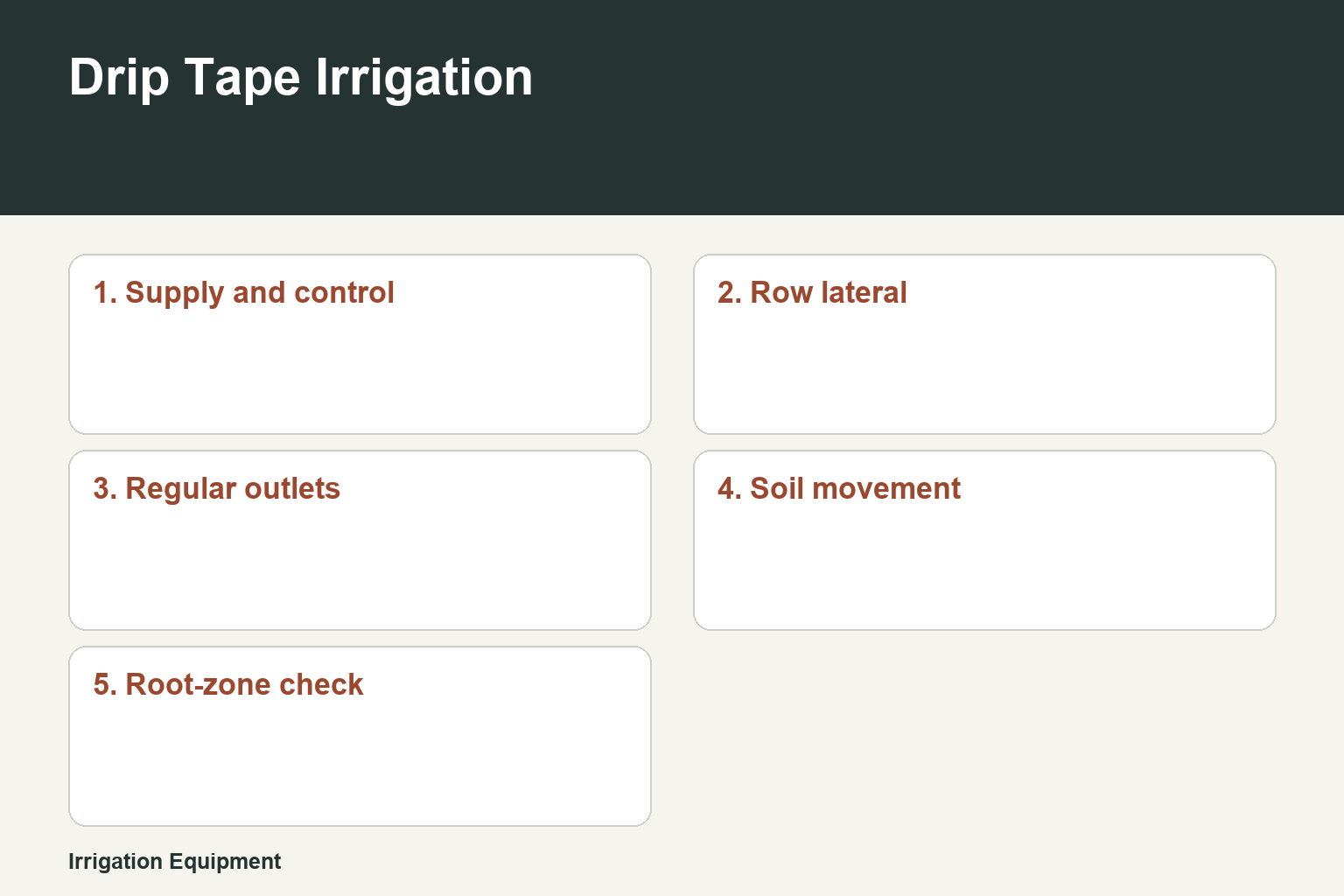
- Supply and controlWater passes through the system’s control, filtration, and pressure-regulation components.
- Row lateralA low-flow lateral carries water along the planted row.
- Regular outletsLine emitters release small flows near the plants.
- Soil movementCapillary action and gravity spread water outward and downward.
- Root-zone checkSubsurface inspection shows whether the wetted pattern matches the plants’ roots.
The lateral remains in place while water exits through line emitters; the soil, rather than a moving tape, distributes water through the root area.
How drip tape waters a planting row
A drip-tape lateral runs beside or along a row and releases water gradually through line emitters. Rather than wetting every inch of the surface uniformly, it creates wetted zones that spread outward and downward in the soil. Soil texture and structure influence how that water moves, so the visible surface is not a reliable measure of how much of the root zone has been irrigated. I would treat a quick check below the surface as the practical test of whether the placement and schedule are working.
- The supply line brings water to the lateral.
- The lateral applies low flow near the plants.
- Soil movement distributes that water through the root area.
- Excess run time can still carry water below the roots.
Sources: USDA NRCS National Engineering Handbook, Part 652, sections 652.0603 and 652.0900 · EPA WaterSense homeowner microirrigation guide
Choose drip tape when plant spacing calls for a row system
Line emitters are intended for rows of plants, while individual point emitters are better suited to widely spaced plants that need targeted delivery. Drip tape is therefore a row-layout decision, not a universal substitute for every outdoor watering method. Beds, vegetables, shrubs, and containers can suit microirrigation, but turf generally needs a coverage pattern that drip tape does not provide.
| Planting pattern | Best-matched delivery approach | Reason |
|---|---|---|
| Closely planted vegetable row | Line emitters or drip-tape lateral | Regular outlets can serve the length of a row. |
| Widely spaced individual plants | Point emitters | Delivery can be directed to each plant. |
| Several spots from one location | Multioutlet emitter | One emitter divides delivery among outlets. |
| Turf area | Different coverage approach may be needed | Turf may require coverage beyond what drip provides. |
Sources: USDA NRCS National Engineering Handbook, Part 652, sections 652.0603 and 652.0900 · EPA WaterSense homeowner microirrigation guide
Plan the system around water demand and uniform delivery
A functional system combines a water supply, shutoff or controls, filtration, pressure regulation, distribution tubing or laterals, and emitters. Group plants with similar water needs, soil conditions, and sun exposure so one valve schedule is not trying to satisfy incompatible areas. The total demand from the emitters must fit the available flow and the product’s limits. Changes in pressure and elevation can make application less uniform; pressure-compensating emitters work only within the range specified by their manufacturer.
1Map irrigation zones
Separate areas with different plant needs, soil, or sun exposure before deciding where each row lateral will run.
2Match the layout to the water source
Add up the emitter demand for a zone and keep the design within the available flow and applicable product limits.
3Include protection and control components
Place filtration and pressure regulation in the system, then use a shutoff or automated valve control as appropriate for the layout.
Sources: USDA NRCS National Engineering Handbook, Part 652, sections 652.0603 and 652.0900 · EPA WaterSense homeowner microirrigation guide
Install, flush, and verify the wetting pattern
After the lateral is connected, flush installation debris before relying on the system for irrigation. Then run the zone and inspect the soil beneath the surface near representative plants. This reveals whether water is reaching the root area and whether it is moving too deeply. Adjusting runtime should follow what the root-zone check shows, not simply the fact that the tape uses low flow.
1Flush before normal use
Clear installation debris from the system so small emitter passages are less likely to clog.
2Run one zone at a time
Observe the system operating and look for leaks or damaged laterals.
3Check below the soil surface
Examine wetting in the root area at representative locations, including places affected by elevation differences.
4Continue periodic inspection
Watch for clogging, leaks, and damage from rodents, and correct issues before they create dry sections or waste water.
| Check | What it helps prevent or reveal | When to do it |
|---|---|---|
| Emitter demand versus available flow | A zone that exceeds the water source or product limits | During planning |
| Filtration and flushing | Debris reaching small passages | Before normal operation |
| Pressure and elevation effects | Uneven delivery across the layout | During setup and inspection |
| Subsurface root-zone wetting | Shallow watering or deep percolation | After a representative run |
| Leaks, clogs, and rodent damage | Dry areas and unintended water loss | Periodically |
Sources: USDA NRCS National Engineering Handbook, Part 652, sections 652.0603 and 652.0900
Use scheduling as a root-zone adjustment, not a fixed ritual
Low-flow irrigation is not automatically light irrigation. A long enough run can overwater a bed or push water beyond the active roots through deep percolation. Timers and soil-moisture controls can automate valves, but they do not replace checking whether the chosen schedule matches the soil and plants. Reassess zones as plant needs or conditions differ across the garden.
- Water needs should be grouped by plant type, soil, and exposure.
- A wet-looking surface alone does not confirm adequate root-zone moisture.
- Automation can operate valves; it does not guarantee a suitable schedule.
Sources: USDA NRCS National Engineering Handbook, Part 652, sections 652.0603 and 652.0900 · EPA WaterSense homeowner microirrigation guide
Frequently Asked Questions
Is drip tape the same as a soaker hose?
Both can water close to the soil, but this article uses drip tape to mean a row lateral with regularly spaced line emitters. Design and operating details depend on the specific product, so do not assume fittings, pressure requirements, or maintenance instructions transfer between products.
Can one drip-tape zone water vegetables and shrubs together?
Only if their water needs and growing conditions are compatible. Grouping by plant needs, soil, and sun exposure helps one valve schedule serve the area more appropriately.
Why is one end of a row drier than the other?
Pressure variation and elevation can affect uniformity. Check for leaks, clogging, damage, and differences in wetting along the lateral; a system also needs to stay within its applicable flow and product limits.
Do I need filtration for drip tape irrigation?
Yes. Microirrigation has small passages that should be protected with filtration. Flushing installation debris and periodically checking for clogging are also part of keeping delivery consistent.
Can drip tape overwater plants?
Yes. Low flow does not prevent overwatering. If a zone runs too long, water can move below the root area, so inspect subsurface wetting and adjust the schedule accordingly.
Final Thoughts
Set drip tape up as a row-specific microirrigation system, then let subsurface wetting—not surface appearance—guide the schedule. Filtration, flushing, and periodic checks are what keep its low-flow delivery useful across the season.