
THE WATERING PLAN · EQUIPMENT GUIDE
Choosing drip irrigation tubing starts with deciding whether you need a blank supply line or dripline with emitters already inside. The first gives you freedom to place emitters where individual plants need them. The second simplifies closely spaced rows by putting water outlets at fixed intervals.
This selection spans short 1/4-inch feeder tubing, 100- and 200-foot emitter lines, and 500-foot mainline coils. Diameter, roll length, emitter spacing, and fitting compatibility matter more than a generic claim that tubing works for gardens. Match the line to the layout you are actually building before adding connectors or emitters.
Top Drip Irrigation Tubing on the Market

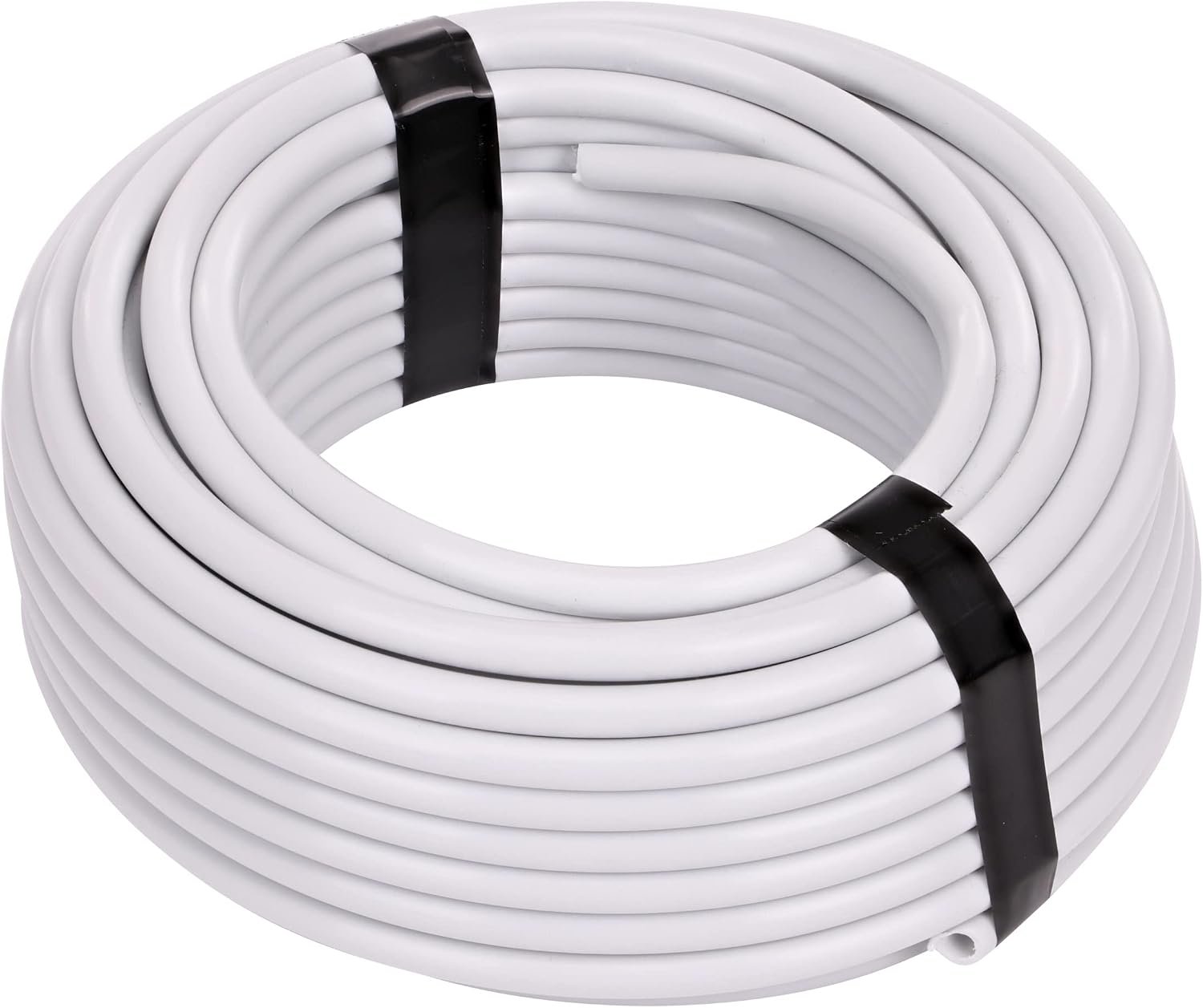
Raindrip R255DT 1/4-Inch White Tubing
- 50-foot 1/4-inch supply tubing
- 0.250-inch outer diameter
- 0.170-inch inner diameter
- White polyethylene construction
- Compatible with 1/4-inch micro fittings

Raindrip R252DT 1/4-Inch Sand Tubing
- 50-foot 1/4-inch supply tubing
- 0.250-inch outer diameter
- 0.170-inch inner diameter
- Sand polyethylene construction
- Connects with compatible micro fittings

Raindrip 016005P 1/4-Inch Black Tubing
- 50-foot 1/4-inch supply tubing
- 0.250-inch outer diameter
- 0.170-inch inner diameter
- Black polyethylene construction
- For compatible micro-fitting systems

Habitech 100-Foot 1/4-Inch Dripline
- 100-foot 1/4-inch dripline
- 0.5 GPH built-in emitters
- 6-inch emitter spacing
- 19-foot maximum run length
- Couplings and end plugs included

Raindrip 061050 500-Foot Mainline
- 500-foot 5/8-inch supply tubing
- 0.700-inch outer diameter
- 0.600-inch inner diameter
- Accepts punched-in emitters
- Black polyethylene construction

Drip Depot 500-Foot Poly Tubing
- 500-foot 1/2-inch tubing roll
- 60 PSI maximum pressure
- 0.600-inch inner diameter
- 0.700-inch outer diameter
- UV-resistant black polyethylene

WAIWL 200FT 1/4-Inch Emitter Tubing
- 200-foot 1/4-inch dripline
- 0.5 GPH built-in emitters
- 6-inch emitter spacing
- Fittings and end plugs included
- Can be cut for layout changes

WAIWL 50FT 1/2-Inch Mainline
- 50-foot 1/2-inch tubing
- Soft flexible poly tubing
- For compatible 1/2-inch fittings
- Can be cut to length
- For mainline garden routing
Drip Irrigation Tubing Comparison Table
| Product | Best For | Tubing Diameter | Roll Length | Outer Diameter | Material | Inner Diameter |
|---|---|---|---|---|---|---|
| Raindrip R255DT 1/4-Inch White Tubing | For Visible Feeder Lines | 1/4-Inch | 50 Foot | 0.250 in. | White Polyethylene | 0.170. in. |
| Raindrip R252DT 1/4-Inch Sand Tubing | For Sand-Tone Gardens | 1/4-Inch | 50-Foot | 0.250 in. | Sand Polyethylene | 0.170. in. |
| Raindrip 016005P 1/4-Inch Black Tubing | For Darker Exposed Runs | 1/4-Inch | 50-Foot | 0.250 in. | Black Polyethylene | 0.170. in. |
| Habitech 100-Foot 1/4-Inch Dripline | For Short Planted Rows | 1/4″ | 100 Ft Roll | Not Specified | Not Specified | Not Specified |
| Raindrip 061050 500-Foot Mainline | For Long Mainline Layouts | 5/8-Inch | 500-Foot | 0.700 in. | Polyethylene | 0.600 in. |
| Drip Depot 500-Foot Poly Tubing | For 60 PSI Systems | 1/2″ | 500 Ft Roll | 0.700″ OD | Black Polyethylene | 0.600″ ID |
| WAIWL 200FT 1/4-Inch Emitter Tubing | For Extended Row Layouts | 1/4 | 200FT | Not Specified | Not Specified | Not Specified |
| WAIWL 50FT 1/2-Inch Mainline | For Flexible Bed Routing | 1/2 Inch | 50 FT | Not Specified | flexible poly tubing | Not Specified |
Detailed Product Reviews
Raindrip R255DT 1/4-Inch White Tubing
- Tubing Diameter
- 1/4-Inch
- Length
- 50 Foot
- Outer Diameter
- 0.250 in.
- Inner Diameter
- 0.170. in.
- Material
- White Polyethylene
Advantages
- Blank line allows custom emitter placement
- 50-foot coil suits compact layouts
- Works with compatible micro fittings
- Specified inner and outer diameters
- Layered polyethylene construction
Limitations
- Emitters and connectors are separate
- Limited to a 50-foot coil
I would choose the Raindrip R255DT when a short, visible feeder line suits the garden plan. This is blank 1/4-Inch tubing, so it carries water from a main supply line to a low-flow device rather than dictating where water exits. Its 50 Foot coil is a sensible scale for containers, hanging baskets, planter boxes, or a compact bed with separately placed emitters.
The 0.250-inch outer diameter and 0.170-inch inner diameter matter when matching fittings. It connects to a main line with a compatible 1/4-inch micro fitting, such as a barbed connector, and can connect directly to an emitter at the other end. The white polyethylene is built in layers, with virgin-content inner and outer layers and a recycled middle layer. Plan the emitter and connector purchases separately because this coil is tubing only.
The Raindrip R252DT is the closest alternative because it has the same stated dimensions and 50-foot length. The practical difference is color: R255DT is white polyethylene, while R252DT is sand polyethylene. Choose this white version when that finish better suits an exposed layout. If tubing will be less noticeable against tan mulch or sandy ground, the R252DT is the better visual match.
Raindrip R252DT 1/4-Inch Sand Tubing
- Tubing Diameter
- 1/4-Inch
- Length
- 50-Foot
- Outer Diameter
- 0.250 in.
- Inner Diameter
- 0.170. in.
- Material
- Sand Polyethylene
Advantages
- Customizable emitter locations
- 50-foot length for smaller systems
- Compatible with 1/4-inch micro fittings
- Specified tubing diameters
- Sand-colored polyethylene
Limitations
- Does not include emitters
- Requires compatible fittings
The Raindrip R252DT is a blank feeder line for gardeners who want to choose every emitter location. Its 1/4-Inch format can feed a low-flow drip device or serve as a main line in a small drip system. That makes the 50-foot roll a good fit for a few pots, a short vegetable row, or a small border where fixed emitter spacing would be restrictive.
This tubing has a 0.250-inch outside diameter and a 0.170-inch inside diameter. Use compatible 1/4-inch micro fittings to join it to a supply line, then route the other end to an emitter. The Sand Polyethylene finish is its defining distinction. Its layered construction uses virgin content on the water-exposed inner layer and sun-exposed outer layer, with recycled content between them. As with other blank tubing, account for emitters, connectors, and end closures in the system plan.
Raindrip’s 016005P has the same stated diameter measurements and 50-foot length, but comes in black polyethylene. Neither color changes the stated tubing role or connection approach. I would select R252DT when sand-colored tubing better fits an exposed bed. Select the black 016005P for an exposed run where a darker line is preferred.
Raindrip 016005P 1/4-Inch Black Tubing
- Tubing Diameter
- 1/4-Inch
- Length
- 50-Foot
- Outer Diameter
- 0.250 in.
- Inner Diameter
- 0.170. in.
- Material
- Black Polyethylene
Advantages
- Blank tubing supports irregular planting
- Black finish for exposed routing
- 50-foot coil is easy to allocate
- Works with compatible micro fittings
- Layered polyethylene construction
Limitations
- No built-in emitters
- Fittings are not included
Choose the Raindrip 016005P when you need a short blank line and prefer a black finish. The 50-Foot coil can route water from a main line to individual emitters in containers, planter boxes, hanging baskets, or compact planting areas. Because it has no integrated outlets, it supports irregular plant spacing better than fixed-spacing dripline.
Its 0.250-inch outer diameter and 0.170-inch inner diameter establish the fitting size to match. A compatible 1/4-inch micro fitting can join the tubing to the main supply line, and an emitter can be connected at the destination. The Black Polyethylene tube uses a layered design with virgin-content outer and inner layers plus a recycled-content middle layer. It is not a complete irrigation kit, so include the fittings, emitters, and end treatment needed for the route.
The Habitech 100-foot dripline takes a different approach. Habitech has 0.5 GPH emitters built in at 6-inch intervals, while the 016005P leaves outlet placement to the installer. Use the Raindrip when plants are unevenly spaced or need individual emitter choices. The Habitech is more suitable for a planted row that already aligns with 6-inch spacing.
Habitech 100-Foot 1/4-Inch Dripline
- Tubing Diameter
- 1/4″
- Length
- 100 Ft Roll
- Emitter Flow Rate
- 0.5 GPH emitters
- Emitter Spacing
- 6-inch intervals
- Maximum Run Length
- 19 ft
Advantages
- Emitters are integrated into tubing
- Six-inch outlet spacing suits dense planting
- 100-foot roll supports multiple branches
- Couplings are included
- End plugs are included
Limitations
- Fixed emitter spacing limits customization
- Each dripline run is limited to 19 feet
The Habitech dripline is for evenly planted beds where installing a separate emitter at every plant would be needless work. It combines tubing and outlets in one line, with 0.5 GPH emitters at 6-inch intervals. That layout is especially direct for closely spaced row crops, flower beds, greenhouse benches, pots, and planter boxes.
Each dripline section has a stated maximum run length of 19 feet, so do not treat the 100-foot roll as one uninterrupted run. Cut it into lengths that fit that limit and lay out the branches accordingly. Five barbed 1/4-inch couplings are included for connection to 1/2-inch mainline tubing, along with 10 goof plugs to close line ends. The tube can also be buried beneath groundcover for subsurface use.
The WAIWL 200FT emitter tubing uses the same stated 0.5 GPH flow and 6-inch emitter spacing, but provides twice the roll length. Habitech is the better match when 100 feet and its stated 19-foot run limit fit a modest layout. Choose the WAIWL 200FT when the design needs more pre-spaced dripline from one roll, while confirming that its routing suits the garden.
Raindrip 061050 500-Foot Mainline
- Tubing Diameter
- 5/8-Inch
- Length
- 500-Foot
- Outer Diameter
- 0.700 in.
- Inner Diameter
- 0.600 in.
- Material
- Polyethylene
Advantages
- 500-foot coil serves extensive layouts
- Can function as a main supply line
- Accepts punched-in emitters
- Feeder lines can connect to tubing
- Specified internal and external diameters
Limitations
- Long coil may exceed small-garden needs
- Appropriate fittings are required
The Raindrip 061050 is the mainline choice for a large system rather than a short feeder branch. Its 500-Foot coil and 5/8-Inch tubing size allow water to be carried through a broad garden layout. You can use it as a main supply line or punch emitters directly into the line, which gives a designer flexibility to build branches and watering points around trees, beds, shrubs, or containers.
The tube measures 0.700 inch outside and 0.600 inch inside. It connects to a point-of-connection device using an appropriate fitting, while emitters and feeder lines can be punched directly into the tubing or attached at its end. Its polyethylene layers use virgin content on the outer and inner layers with recycled material in the middle. For maintenance, remove end closures and flush each circuit once or twice a year until water runs clear. In cold areas, drain the system for winter.
The Drip Depot 500-foot coil shares the same stated 0.600-inch inner diameter and 0.700-inch outer diameter, but is identified as 1/2-inch tubing and carries a 60 PSI maximum pressure rating. Raindrip is the better option when you want the stated ability to punch emitters or feeder lines into the mainline. Consider Drip Depot when a 60 PSI rating is a requirement for the planned low-pressure system.
Drip Depot 500-Foot Poly Tubing
- Tubing Diameter
- 1/2″
- Length
- 500 Ft Roll
- Inner Diameter
- 0.600″ ID
- Outer Diameter
- 0.700″ OD
- Maximum Pressure
- 60 PSI
Advantages
- 60 PSI maximum pressure rating
- 500-foot coil for large layouts
- Specified inner and outer diameters
- UV-resistant polyethylene
- Suitable for drip system water delivery
Limitations
- Needs time to relax after uncoiling
- Long roll can be excessive for short runs
I would choose this Drip Depot tubing when a 500-foot mainline is needed and the system design calls for a stated 60 PSI maximum pressure rating. It is a long black polyethylene coil intended to carry water through drip irrigation layouts for agricultural, landscape, or garden applications. The 500 Ft Roll makes the most sense when several beds or zones need a continuous supply route.
The tubing is identified as 1/2 inch, with a 0.600-inch inner diameter and 0.700-inch outer diameter. Those measurements are the details to match against fittings already in the system rather than relying on the nominal size alone. The black polyethylene is described as UV resistant. Allow time after uncoiling for the tubing to relax and lie flat before final routing, since a tightly coiled line can fight the shape of a planned run.
Raindrip 061050 has the same stated 0.600-inch inner diameter, 0.700-inch outer diameter, and 500-foot length. The difference is functional emphasis: Raindrip is described for punching in emitters or feeder lines, while this Drip Depot model supplies a 60 PSI rating. Choose Drip Depot where that pressure specification is central. Choose Raindrip where the stated punched-emitter mainline configuration is the deciding feature.
WAIWL 200FT 1/4-Inch Emitter Tubing
- Tubing Diameter
- 1/4
- Length
- 200FT
- Emitter Flow Rate
- 0.5 GPH
- Emitter Spacing
- 6 inches
- Included Accessories
- fittings and end plugs
Advantages
- 200-foot roll covers longer layouts
- Integrated emitters reduce separate installation
- Six-inch spacing suits dense rows
- Fittings are included
- End plugs are included
Limitations
- Fixed six-inch spacing may not suit all plants
- 200-foot roll may exceed short-layout needs
The WAIWL 200FT dripline is aimed at larger planted layouts that still use closely spaced emitters. Its 200FT roll has built-in 0.5 GPH emitters every 6 inches, making it a direct option for long raised beds, vegetable rows, flower borders, and greenhouse benches. Cut the tubing to shape branches and extensions around the bed plan rather than adding individual drippers along every row.
The 6-inch outlet interval is useful only when plant spacing suits it. It is less adaptable than blank supply tubing for isolated shrubs, widely spaced containers, or plants with inconsistent positions. Fittings and end plugs are included, which can reduce additional component shopping for a basic extension or repair. Warm the tubing before inserting fittings if needed, and flush the line before sealing its end plugs.
The Habitech 100-foot dripline has the same stated diameter, 0.5 GPH emitter flow, and 6-inch spacing. WAIWL’s advantage is simply the 200FT roll, which provides more line for an extended layout. I would pick Habitech for a smaller build that benefits from its stated 19-foot maximum run length. Pick WAIWL when the needed total of pre-spaced tubing is closer to 200 feet.
WAIWL 50FT 1/2-Inch Mainline
- Tubing Diameter
- 1/2 Inch
- Length
- 50 FT
- Material
- flexible poly tubing
- Compatible Fittings
- 1/2″ irrigation connectors, tees, elbows, end caps
- Tubing Type
- soft, flexible 1/2″ irrigation tubing
Advantages
- 50-foot roll suits smaller projects
- Flexible tubing routes around beds
- Can be cut for custom layouts
- Works with listed 1/2-inch fittings
- Suitable as a garden mainline
Limitations
- Fitting size must be checked before purchase
- Not recommended for unconfirmed rigid PVC fittings
This WAIWL tubing is the compact mainline option for a small raised-bed, greenhouse, lawn-edge, or garden layout. The 50 FT length is easier to size for one modest project than a 500-foot coil. Its 1/2 Inch designation places it in the mainline role, carrying water across the area before compatible drip accessories divide it into watering points.
The soft, flexible poly tubing can be trimmed and routed around bed corners and planting zones. It is designed for compatible 1/2-inch irrigation connectors, tees, elbows, and end caps. Check the actual fitting size before purchase, and do not assume that rigid PVC fittings or punch-in connectors will seal correctly. Setting the coiled tubing in the sun can soften it and reduce the packaging odor before installation.
Raindrip R255DT is a different tool for a different section of the system. The Raindrip is 1/4-inch, 50-foot feeder tubing for routing water to low-flow devices, while this WAIWL line is 1/2-inch mainline tubing for distributing water through a garden layout. Choose WAIWL to establish the short main route. Add a smaller feeder line when the design needs branches to individual emitters.
How to Choose Drip Irrigation Tubing
A reliable drip layout begins with a simple map of the water route. Identify where the mainline starts, where feeder lines split off, and whether plants are evenly spaced enough for integrated-emitter dripline.
Choose Mainline or Feeder
Use larger mainline tubing to move water from the source across the garden, then use smaller tubing to reach individual emitters or short branches. A blank feeder line is useful where plant locations vary. Do not select by nominal diameter alone when connecting existing parts. Compare the stated inner and outer diameters with the fittings you already own.
Decide on Built-in Emitters
Integrated-emitter dripline reduces assembly because water outlets are already positioned along the tube. It works best for rows, dense beds, and other layouts that align with the stated emitter interval. Blank tubing is more adaptable when plants are widely spaced, irregularly arranged, or require different emitter placements. Fixed spacing is a layout commitment, not a universal advantage.
Plan Every Run Length
Measure each branch and main route before choosing a coil length. A longer roll can reduce joins in a large installation, but it also creates more unused tubing in a small project. Follow any stated maximum run length for emitter tubing. Divide a long garden into suitable branches rather than assuming every roll can operate as one continuous watering line.
Match Fittings Carefully
Tubing labels such as 1/4 inch, 1/2 inch, and 5/8 inch describe a category, but fitting success depends on the dimensions and connector type. Use fittings intended for the tubing and confirm compatibility before buying. Barbed connectors, tees, elbows, end caps, and emitter connections all need to suit the specific line in the planned system.
Allow for Coil Memory
Poly tubing arrives coiled and may need time to relax before it follows straight routes or smooth curves. Lay it out before making final cuts and positioning connectors. Sun-warming may help soften flexible tubing for installation where the product directions allow it. Leave enough slack for clean turns instead of forcing sharp bends that complicate routing.
Maintain the Water Route
Use removable end closures where the system design calls for them so circuits can be flushed periodically. Flushing helps clear a line before it is closed and is particularly useful after installation work. In areas with freezing conditions, drain the irrigation system for winter according to the tubing and component guidance to help avoid damage from trapped water.
How We Evaluated Drip Irrigation Tubing
I prioritized the tubing role first: blank feeder line, integrated-emitter dripline, or main supply line. I then compared stated diameter, coil length, emitter flow and spacing where present, pressure information where present, included connection parts, and explicit compatibility limits. The recommendations reflect how those documented details affect the layout a buyer can build, not a claim of measured field performance.
Frequently Asked Questions
What is the difference between blank tubing and dripline?
Blank tubing carries water without preset outlets, so you add emitters and fittings where needed. Dripline has emitters built into the tube at fixed intervals. Blank tubing suits irregular plant placement, while dripline is often easier for evenly spaced rows and beds.
Can 1/4-inch tubing be used as a mainline?
It can serve as a main line in a small drip system when the product is intended for that role. For a broader layout, larger supply tubing is generally used to carry water across the area before smaller feeder lines branch to individual watering points.
Why should I check inner and outer diameter?
Nominal tubing size alone does not guarantee a fitting match. Inner and outer diameter measurements help you compare tubing with barbed connectors, point-of-connection devices, and other existing parts. Check both the tubing dimensions and the fitting type before building the system.
Are built-in emitters suitable for containers?
They can be, provided the fixed emitter spacing aligns with the container layout and each cut section can be connected and closed properly. For scattered containers with different positions, blank tubing and separately placed emitters usually offer more control over where water is delivered.
How do I determine the right tubing length?
Measure the main route and every branch, then include enough length for turns, connections, and endpoints. Choose a roll that covers the plan without creating an impractical surplus. If dripline specifies a maximum run length, size each branch to stay within that stated limit.
Do I need to flush drip irrigation tubing?
Flushing is useful before closing a newly assembled line and as periodic system maintenance where the product guidance calls for it. Systems with removable end closures make this easier. For cold climates, drainage before freezing weather is also an important seasonal planning step.
Final Thoughts
My main recommendation for evenly spaced garden rows is the Habitech 100-foot dripline because it pairs built-in 0.5 GPH emitters with a stated 6-inch spacing and 19-foot maximum run length. Choose the WAIWL 200FT dripline when the layout needs more pre-spaced tubing. For a larger blank mainline, the Raindrip 061050 is the more flexible choice when punching in emitters or feeder lines is part of the design.