
THE WATERING PLAN · EQUIPMENT GUIDE
A drip irrigation timer needs to match the layout of your watering system before anything else. The key divide here is between a straightforward analog controller for a single hose connection, a digital timer with detailed run-time settings, and a two-zone model for separate areas that need independent schedules.
All three options provide scheduled watering and rain-delay functions, but their controls and connections serve different setups. I would start by deciding whether one outlet is enough, then choose the programming range and fitting details that suit your faucet, tubing transition, and watering routine.
Top Drip Irrigation Timers on the Market

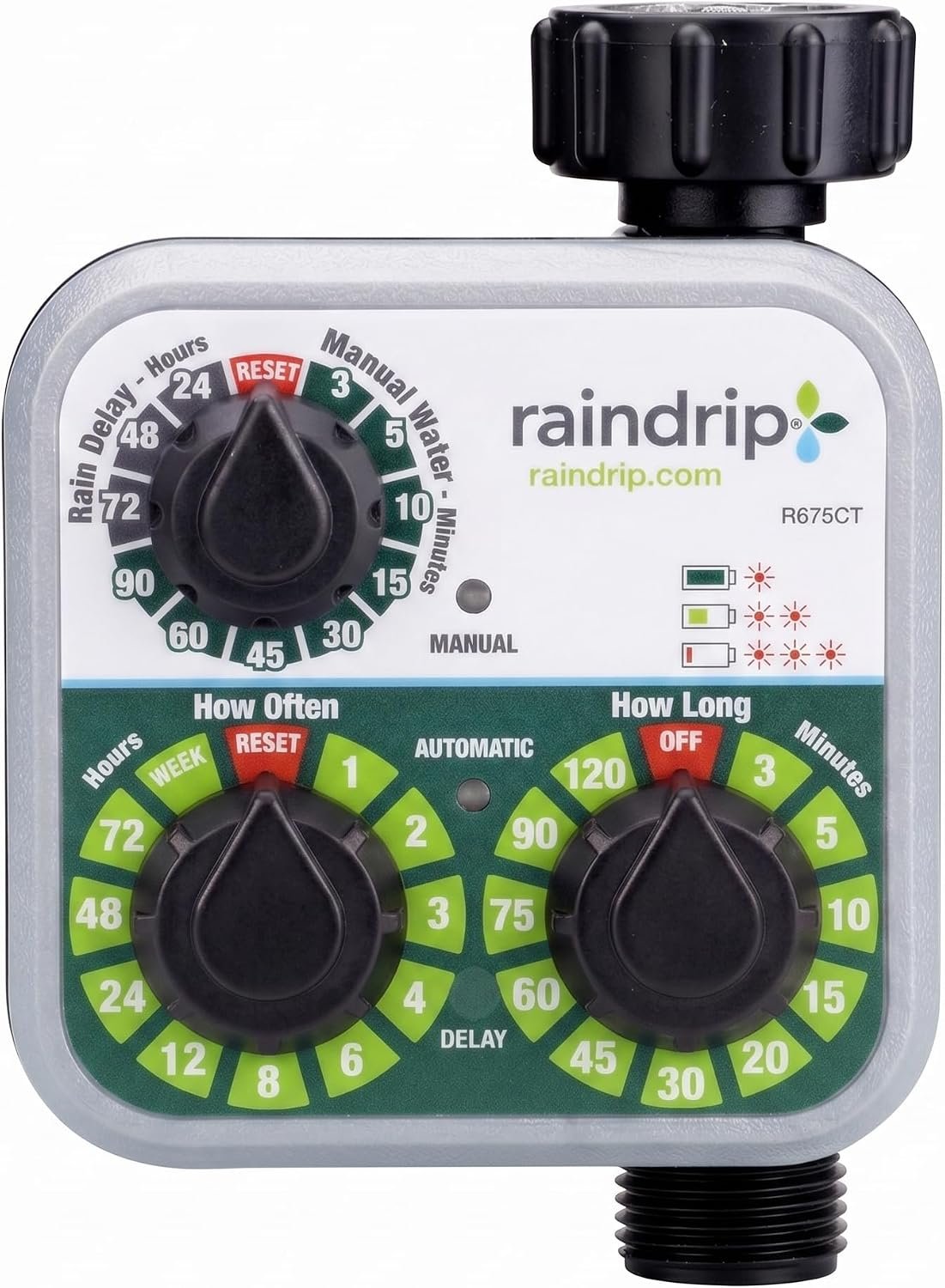
Raindrip R675CT Analog 3-Dial Timer
- Three control dials
- 24 to 72 hours rain delay
- Garden Hose Thread compatibility
- Timed manual watering
- Battery-operated shutoff protection

RAINPOINT Brass Inlet & Outlet Timer
- Pure brass inlet and outlet
- Maximum pressure of 116psi
- 1 minute to 3 hours 59 minutes
- 1 hour to 7 day frequency
- Large LCD display

RAINPOINT 2 Outlet Sprinkler Timer
- Two independently programmable zones
- Up to 38 watering programs
- 1 minute to 3 hours 59 minutes
- Individual or simultaneous manual modes
- Low-battery alert below 5%
Drip Irrigation Timer Comparison Table
| Product | Best For | Rain Delay | Watering Duration | Watering Frequency | Manual Duration |
|---|---|---|---|---|---|
| Raindrip R675CT Analog 3-Dial Timer | For Simple Analog Scheduling | 24 to 72 hours | Not Specified | Not Specified | Not Specified |
| RAINPOINT Brass Inlet & Outlet Timer | For Detailed Digital Scheduling | 24, 48, or 72 hours | 1min-3h59min | 1h to 12h or 1 day to 7 days | 1 min to 8 hrs |
| RAINPOINT 2 Outlet Sprinkler Timer | For Two-Zone Watering | Not Specified | 1min to 3 hrs 59 mins | 1 hour to 12 hours, Day mode is from 1 day to 7 days | 1min to 8hrs |
Detailed Product Reviews
Raindrip R675CT Analog 3-Dial Timer
- Rain Delay
- 24 to 72 hours
- Connection Compatibility
- Garden Hose Thread (GHT)
- Power Source
- Battery-operated timer
Advantages
- Three dedicated control dials
- 24 to 72 hour rain delay
- Timed manual watering preserves schedule
- GHT faucet connection
- Valve shuts off on battery depletion
Limitations
- Requires batteries, which are not included
- Needs an adapter for supply tubing
I would choose the Raindrip R675CT for a single drip line when straightforward dial controls matter more than detailed digital programming. Its three dials set watering frequency, run time, and an override function, so the routine is built around a repeatable schedule rather than screen-based menus. The 24 to 72 hours rain delay is useful when wet weather makes a planned cycle unnecessary, while timed manual watering can run without changing the established program.
This timer connects at an outdoor faucet or hose bibb and uses Garden Hose Thread (GHT) connections. That makes connection type the first setup check. A GHT-to-tubing adapter is needed to transition from the outlet to the desired supply-tubing size, and that adapter is not included. The battery-operated design also gives a low-battery indication and turns the valve off when batteries run out. Buyers should plan to supply the batteries.
Compared with the RAINPOINT Sprinkler Timer with Brass Inlet & Outlet, the Raindrip R675CT favors immediate analog operation over a display with specified minute-by-minute duration ranges. Choose Raindrip when a faucet-fed drip setup benefits from physical dials and a GHT connection. Choose the digital RAINPOINT when setting a defined start time and a watering duration from one minute upward is central to the plan.
RAINPOINT Brass Inlet & Outlet Timer
- Inlet And Outlet
- pure brass water inlet and outlet metal thread
- Maximum Pressure
- 116psi
- Watering Duration
- 1min-3h59min
- Watering Frequency
- 1h to 12h or 1 day to 7 days
- Rain Delay
- 24, 48, or 72 hours
Advantages
- Pure brass inlet and outlet
- Stated maximum pressure of 116psi
- Duration starts at one minute
- Hourly through weekly frequency options
- Large LCD shows program details
Limitations
- Manual watering is limited to eight hours
The RAINPOINT Sprinkler Timer with Brass Inlet & Outlet is the pick for a one-line watering plan that needs closely defined timing. You can set a start time, a 1min-3h59min watering duration, and a frequency ranging from hourly intervals to weekly intervals. That range suits drip irrigation where a short, frequent cycle and a longer garden-hose cycle may call for different calendar settings.
The connection hardware is its clearest practical distinction. It has pure brass water inlet and outlet metal thread and a stated maximum pressure of 116psi. Built-in metal filter gaskets are intended to keep larger sediment out of the irrigation system. The large LCD displays watering time, frequency, and power information, which helps when checking the programmed settings. Rain delay can pause the program for 24, 48, or 72 hours, and manual watering can run for one minute to eight hours without interrupting the schedule.
The RAINPOINT two-outlet timer is the better match when two areas need separate schedules. This model instead concentrates its controls on one watering path, with the stated brass inlet and outlet and 116psi maximum pressure. I would choose this version for a single soaker hose or drip zone where timing precision and the documented fitting construction take priority over independent zone control.
RAINPOINT 2 Outlet Sprinkler Timer
- Zones
- 2 zones
- Programs
- 1-38 PROGRAMS
- Watering Duration
- 1min to 3 hrs 59 mins
- Watering Frequency
- 1 hour to 12 hours, Day mode is from 1 day to 7 days
- Manual Watering Duration
- 1min to 8hrs
Advantages
- Two independently scheduled zones
- Up to 38 watering programs
- Hourly and daily frequency modes
- Manual control for either or both zones
- Low-battery valve shutoff
Limitations
- Automatic watering tops out at 3 hours 59 minutes
The RAINPOINT Sprinkler Timer 2 Outlet is built for a faucet that feeds two areas with different watering needs. It supports 2 zones, with each zone assigned its own watering frequency, start time, duration, and end time. That is the meaningful reason to select it over a one-outlet timer. A drip bed and a second hose-fed area can follow separate schedules rather than sharing one program.
Programming covers hourly intervals from one to 12 hours and daily intervals from one to seven days. Automatic cycles can run from one minute to 3 hrs 59 mins, while manual watering runs from one minute to eight hours. Separate Zone 1, Zone 2, and Both Zone manual and automatic modes allow either outlet to run alone or both to run together. The display gives a low-battery alert below 5%, and the valve automatically shuts off at that point.
Against the RAINPOINT Sprinkler Timer with Brass Inlet & Outlet, this model makes its strongest case through independent two-zone programming and up to 38 programs. The brass-inlet model documents brass fittings and a 116psi maximum pressure, while this two-outlet model documents the additional scheduling flexibility. My recommendation is to choose the two-outlet timer when separate zones are the problem to solve, not simply because more settings are available.
How to Choose a Drip Irrigation Timer
Choose the timer around the number of watering zones, the connection at your faucet, and the schedule your plants actually need. A timer automates valve opening and closing, but it does not replace checking tubing, emitters, and the water source before leaving a system unattended.
Count Your Watering Zones
One outlet works when every connected area can share the same start time, duration, and frequency. Choose two independently controlled outlets when separate beds or watering methods need different schedules. Splitting a single outlet after the timer does not create independent programming, so decide on zone count before buying fittings or adapters.
Confirm Faucet Threads
Hose-end timers connect at a faucet or hose bibb, but thread standards and tubing transitions still matter. Confirm the timer’s stated thread compatibility, then identify the adapter needed between the timer outlet and your irrigation supply tubing. Do not assume an adapter is included just because the timer can be used with drip irrigation.
Set Useful Time Ranges
Look at both duration and frequency. Short run times can suit frequent drip cycles, while longer durations accommodate other hose-connected watering tasks. Frequency settings determine how often the valve opens, so hourly options and day-based options solve different scheduling needs. Pick ranges that cover the schedule you intend to use rather than paying for programs you will not set.
Use Rain Delay Well
Rain delay temporarily pauses a scheduled program and is useful when natural rainfall makes the next watering cycle unnecessary. Check the available delay intervals and whether the timer resumes the existing program afterward. Manual watering is a separate convenience feature, particularly when you need extra water without rebuilding the automatic schedule.
Plan for Battery Checks
Battery-powered hose timers need periodic attention because a depleted battery can interrupt scheduled watering. A low-battery indicator provides advance notice where included, while an automatic valve shutoff can help stop water flow when power is exhausted. Keep the timer accessible enough to inspect its display or indicators during the watering season.
How We Evaluated Drip Irrigation Timers
I evaluated these drip irrigation timers by the decisions that change a purchase: outlet count, documented timing ranges, frequency options, rain-delay controls, manual operation, faucet connection details, and battery safeguards. The recommendations prioritize the supported differences between models rather than treating more programs or a different control style as automatically better for every garden.
Frequently Asked Questions
Can one timer control more than one drip zone?
A single-outlet timer can feed multiple lines only when they share the same watering schedule. For independent start times, durations, or frequencies, use a timer with separately programmable outlets or add separate control equipment designed for that purpose.
What is the difference between run time and watering frequency?
Run time is how long the valve stays open during one cycle. Watering frequency is how often that cycle repeats. For example, a timer may run for minutes at a time while repeating on an hourly or day-based interval.
Does rain delay erase the programmed schedule?
Rain delay is intended to pause scheduled watering for a chosen period. On timers that specify automatic resume, the regular program continues after the delay ends. Check the individual timer’s control description before relying on that behavior.
Why does thread compatibility matter for a hose timer?
The timer must attach correctly to the faucet, and its outlet must transition correctly to the irrigation tubing. A timer specified for Garden Hose Thread may need an additional adapter to connect to the supply tubing used by a drip system.
When should I use manual watering?
Manual watering is useful for an extra watering session outside the programmed cycle. A timer with a manual mode that preserves the schedule can add water without requiring you to change and later rebuild the automatic settings.
Are two outlets always better than one?
No. Two outlets are valuable when two areas need independent programs. If every connected line follows the same schedule, a one-outlet timer is simpler to program and avoids adding zone controls that do not solve a real watering need.
Final Thoughts
For a basic faucet-fed drip setup, I would choose the Raindrip R675CT when analog dials and GHT compatibility fit the installation. The RAINPOINT Brass Inlet & Outlet Timer is the better single-path option for defined digital timing and documented brass connections. Choose the RAINPOINT 2 Outlet Sprinkler Timer when two areas need independent schedules, which is the clearest reason to step up to a dual-zone controller.