
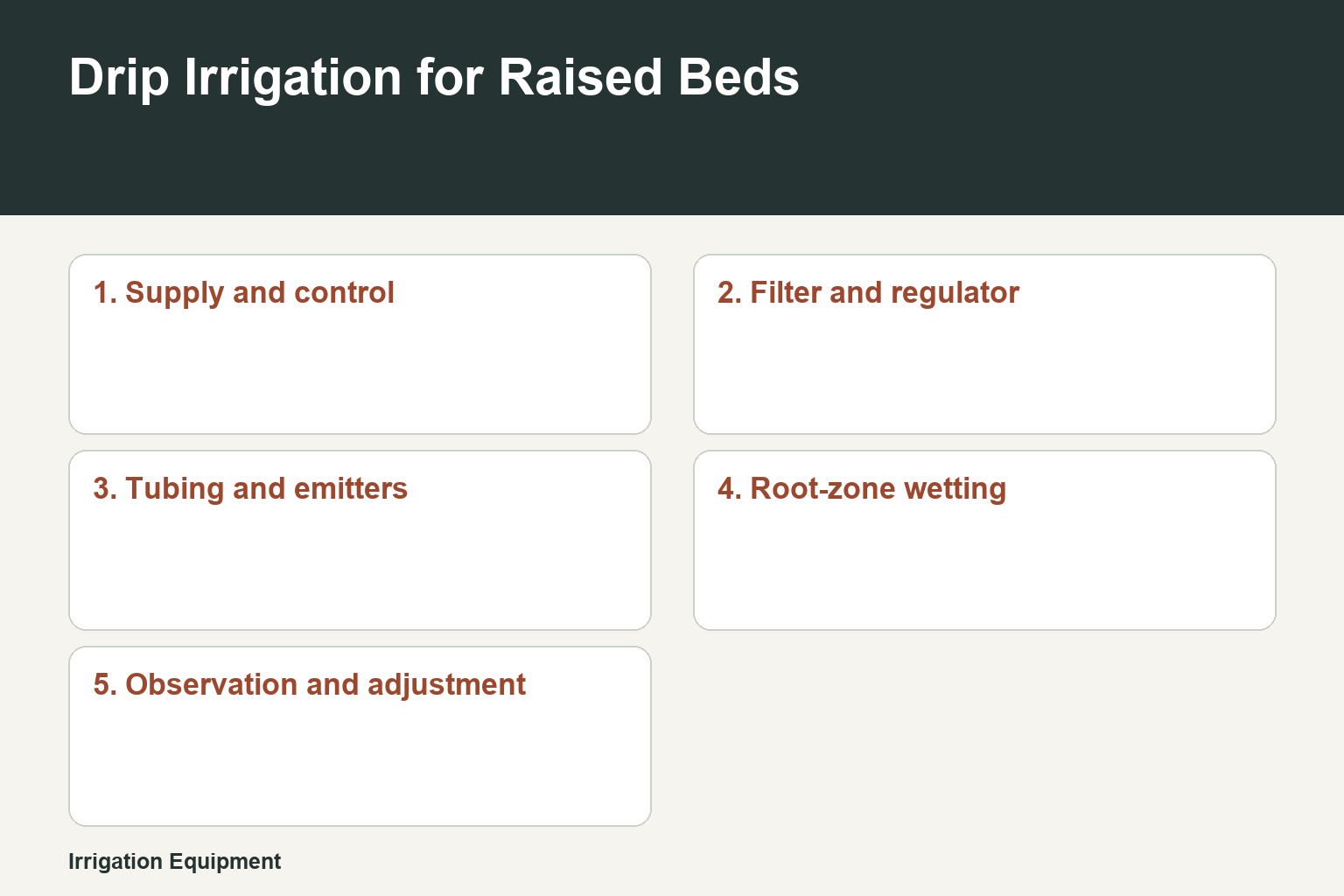
Drip irrigation for raised beds sends small, slow amounts of water through tubing and emitters placed near plant roots. Water then spreads through the bed by capillary action and gravity, so the goal is not to wet every inch of surface at once, but to create adequate root-zone moisture without runoff or unnecessary deep drainage.
For most raised beds, the useful choice is between inline-emitter tubing for planted rows and individual emitters for widely spaced plants. A well-planned system also needs filtration, pressure regulation, and a way to shut off or control the water.
- Supply and controlWater enters through the supply and passes a shutoff, valve, timer, or moisture-based control.
- Filter and regulatorFiltration protects small passages; pressure regulation conditions flow for the equipment.
- Tubing and emittersDistribution tubing carries water to inline or point emitters positioned for the planting layout.
- Root-zone wettingWater leaves each emitter, then moves through soil by capillary action and gravity toward and below roots.
- Observation and adjustmentCheck subsurface wetting, then watch for clogs, leaks, or damage that changes delivery.
Water moves through fixed tubing to emitters; the emitters release it while the surrounding soil spreads the moisture through the root zone.
How drip watering behaves in a raised bed
An emitter releases water at one location; the soil, rather than a spray pattern, distributes it outward and downward. How far that moisture reaches depends on the soil, emitter flow, run time, emitter spacing, and the plants’ root area. That is why a bed can look dry at the surface while moisture is available below it. In my view, checking below the surface is the clearest way to judge a drip layout instead of relying on how the bed looks from above.
- Slow application focuses water in the root zone.
- Low flow still can overwater a bed if water moves below the active roots.
- Different soils can produce different wetting patterns from the same emitter arrangement.
Sources: USDA NRCS National Engineering Handbook, Part 652, sections 652.0603 and 652.0900 · EPA WaterSense homeowner microirrigation guide
Choose the emitter layout to match the planting pattern
Use the planting arrangement to choose the delivery method. Inline-emitter tubing is designed for regularly planted rows, while point emitters allow water to be directed to individual, separated plants. Multioutlet emitters can divide water among several nearby destinations. Keeping plants with similar water needs, soil conditions, and sun exposure together makes a zone easier to manage.
| Planting pattern | Best-matched delivery | Planning implication |
|---|---|---|
| Regular vegetable rows | Inline-emitter tubing | Place the line along the planted row. |
| Widely spaced plants | Individual point emitters | Target each plant’s root area. |
| Several close destinations | Multioutlet emitter | Split delivery among nearby plants. |
Sources: USDA NRCS National Engineering Handbook, Part 652, sections 652.0603 and 652.0900 · EPA WaterSense homeowner microirrigation guide
Plan the system as connected functions, not just a hose
A raised-bed drip system needs a water supply, a shutoff or control, filtration, pressure regulation, distribution tubing, and emitters. These functions work together: filtration protects small emitter passages, regulation helps keep delivery consistent, and the tubing carries water to the selected layout. Before expanding a system, match the combined emitter demand to the available water flow and the product limits.
1Group compatible beds
Put plants with comparable water needs and similar soil and sun conditions on the same watering zone where practical.
2Select the delivery layout
Use line emitters for rows or point emitters for separated plants, then arrange tubing so water reaches the intended root areas.
3Protect and verify the system
Include filtration and pressure regulation as specified for the equipment. After installation, flush debris from the system and inspect the wetting below the soil surface.
| System function | What it does | Why it matters in a bed |
|---|---|---|
| Filtration | Removes material before it reaches small passages | Helps reduce emitter clogging. |
| Pressure regulation | Controls pressure supplied to the drip equipment | Supports more consistent delivery. |
| Control or shutoff | Starts, stops, or automates water flow | Allows a zone to be managed as a unit. |
| Distribution tubing and emitters | Carries and releases water | Places water near intended roots. |
Sources: USDA NRCS National Engineering Handbook, Part 652, sections 652.0603 and 652.0900 · EPA WaterSense homeowner microirrigation guide
Operate by observing moisture, not by assuming a fixed schedule
A timer or soil-moisture control can automate valves, but it does not replace observation. Inspect whether water is reaching the intended root zone and whether it is moving too deeply. Also periodically check for clogged emitters, leaks, and damage to tubing, including rodent damage. Elevation and pressure differences can affect uniformity; pressure-compensating emitters work only within the range specified by their manufacturer.
- Flush installation debris before relying on the system.
- Inspect emitters and tubing during the season.
- Adjust operation when the observed wetting pattern does not match plant root needs.
Sources: USDA NRCS National Engineering Handbook, Part 652, sections 652.0603 and 652.0900
Where drip is a good fit—and where its coverage differs
Drip is well suited to vegetable beds, planted beds, shrubs, and containers because it can apply water slowly near roots. It is not intended to create the broad, uniform surface coverage generally needed for turf. Within raised beds, the practical exception is a mixed planting: separate row crops from isolated larger plants when their placement or water needs call for different emitter arrangements.
Sources: EPA WaterSense homeowner microirrigation guide · USDA NRCS National Engineering Handbook, Part 652, sections 652.0603 and 652.0900
Frequently Asked Questions
Should the entire raised-bed surface become wet?
Not necessarily. Drip is intended to supply the root zone, and soil spreads water from each emitter. Check moisture below the surface to see whether the wetted area matches the plants’ roots.
Can drip irrigation overwater raised beds?
Yes. A low-flow system can still apply more water than roots use and send water below the root zone. Observe the soil wetting pattern and adjust operation accordingly.
Why does a drip system need a filter?
Emitters and other small passages can clog. Filtration helps protect those passages, and flushing removes installation debris.
Do uphill and downhill beds water the same way?
Not automatically. Pressure variation and elevation can affect delivery uniformity. Pressure-compensating emitters must be used within their manufacturer-specified operating range.
Final Thoughts
For drip irrigation in raised beds, start with the plant layout, protect the emitters with filtration and proper pressure control, then confirm the actual moisture pattern below the soil rather than judging by a dry-looking surface.