
THE WATERING PLAN · EQUIPMENT GUIDE
Low water pressure can leave sprinkler zones underperforming, make tank-fed systems frustrating, or limit how much water reaches a garden at once. The right irrigation booster pump depends first on the water source, electrical supply, required lift, and whether you need an automatic on-demand pump or a higher-flow centrifugal model.
These seven options split into two practical groups. The AQUASTRONG jet pumps prioritize high-volume sprinkler duty, while the diaphragm and self-priming models suit smaller transfer, hose, RV, and on-demand water setups. Connection size and pressure control matter just as much as motor power.
Top Irrigation Booster Pumps on the Market

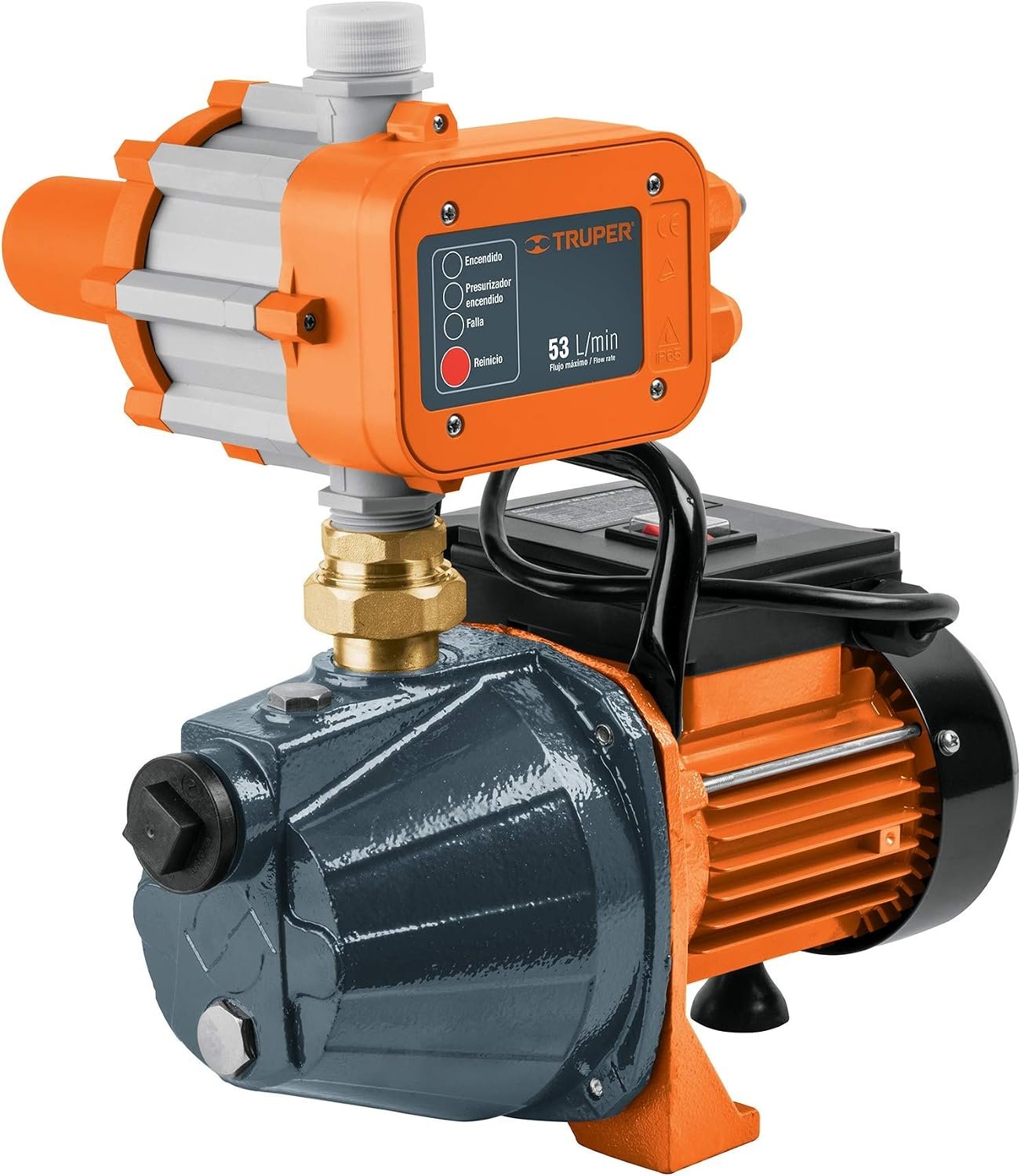
Truper PRES-1 1 HP Booster Pump
- 1 horsepower electric motor
- Automatic flow-switch operation
- Built-in thermal protection
- For automatic yard sprinklers

AQUASTRONG 2 HP Jet Pump
- 2 HP motor
- Maximum flow of 5200 GPH
- Maximum head of 108 ft
- 230 V power supply
- 2-inch NPT suction connection

FlowFluid 45PSI Diaphragm Pump
- 110V self-priming pump
- 4 gallons per minute flow
- 45PSI pressure setting
- 100 ft maximum lifting height
- Automatic start and stop

AQUASTRONG 1.5 HP Dual-Voltage Pump
- 1.5 HP motor
- 115/230 V dual voltage
- Maximum flow of 4250 GPH
- Maximum head of 108 ft
- 2-inch NPT suction connection

TDRRICH 5.5GPM Adjustable Diaphragm Pump
- 110V diaphragm pump
- 5.5 gallons per minute flow
- 30PSI to 75PSI range
- 160 ft maximum lifting height
- Automatic faucet start and stop

AIDPATH 1HP Self-Priming Booster Pump
- 1HP motor
- 792.5 GPH maximum flow
- 164 ft maximum head
- 25 ft self-priming depth
- 1-inch NPT inlet and outlet

ECO-WORTHY 5.5GPM 70PSI Diaphragm Pump
- 110V AC diaphragm pump
- 5.5 gallons per minute flow
- 70PSI pressure setting
- 131 ft maximum lift
- 9.8 ft self-priming depth
Irrigation Booster Pump Comparison Table
| Product | Best For | Automatic Operation | Maximum Flow | Maximum Head | Thermal Protection | Voltage |
|---|---|---|---|---|---|---|
| Truper PRES-1 1 HP Booster Pump | For Automatic Inline Boosting | automatically activates the pump | Not Specified | Not Specified | Built-in automatic thermal protection | Not Specified |
| AQUASTRONG 2 HP Jet Pump | For High-Volume Irrigation | Not Specified | MAX.Q 5200 GPH | Max Head 108 ft | automatic thermal overload protector | 230 V |
| FlowFluid 45PSI Diaphragm Pump | For 45PSI On-Demand Use | automatically start and stop | 4 gallons per minute water flow | max lifting height of 100ft | Thermal overload protection | 110V |
| AQUASTRONG 1.5 HP Dual-Voltage Pump | For Flexible Voltage Setup | Not Specified | MAX.Q 4250 GPH | Max Head 108 ft | automatic thermal overload protector | 115/230 V |
| TDRRICH 5.5GPM Adjustable Diaphragm Pump | For Adjustable Pressure | automatically turn on when the faucet is opened and stop when the faucet is closed | flow rate of 5.5 gallons per minute | maximum lifting height is 160 feet | Not Specified | 110V |
| AIDPATH 1HP Self-Priming Booster Pump | For Shallow-Well Supply | automatic start and stop operation | max flow: 792.5 GPH | max head: 164 ft | Not Specified | Not Specified |
| ECO-WORTHY 5.5GPM 70PSI Diaphragm Pump | For 70PSI Fresh-Water Boosting | Water supply when the faucet is opened, and power off when the faucet is closed | 5.5 gallons per minute water flow | lift up to 131 feet | Thermal overload protection | 110V AC |
Detailed Product Reviews
Truper PRES-1 1 HP Booster Pump
- Rated Motor Power
- 1 horsepower electric motor
- Automatic Operation
- automatically activates the pump
- Thermal Protection
- Built-in automatic thermal protection
- Application
- automatic yard sprinklers
Advantages
- 1 horsepower electric motor
- Automatic start with water demand
- Automatic shutoff when flow stops
- Built-in thermal protection
- Specified for yard sprinklers
Limitations
- No flow rate is stated
- No connection size is stated
I would choose the Truper PRES-1 when an existing water line needs automatic pressure boosting for residential utility use and automatic sprinklers. Its 1 horsepower electric motor is paired with automatic activation, so the pump is intended to respond when water demand begins rather than requiring a separate manual start for each use.
The key convenience is the automatic flow switch activation. It turns the pump on when a faucet or shower opens and turns it off when flow stops. Built-in automatic thermal protection adds a motor shutoff response if overheating occurs. This makes it better suited to an inline pressure-boosting role than to a source-pump installation where suction depth, head, and connection dimensions must be planned around published figures.
Compared with the FlowFluid 45PSI diaphragm pump, the Truper is the more direct choice for a whole-house-style inline booster and automatic yard-sprinkler application. The FlowFluid provides stated flow, lift, and pressure figures for smaller clean-water transfer arrangements. Choose the Truper when automatic inline boosting is the central requirement, not when those quantified diaphragm-pump limits drive the design.
AQUASTRONG 2 HP Jet Pump
- Rated Motor Power
- 2 HP
- Voltage
- 230 V
- Maximum Flow
- MAX.Q 5200 GPH
- Maximum Head
- Max Head 108 ft
- Suction Connection
- 2″ NPT suction
Advantages
- 2 HP motor
- Maximum flow of 5200 GPH
- 108 ft maximum head
- 2-inch NPT suction
- Automatic thermal overload protection
Limitations
- Requires 230 V power
- Fixed 230 V voltage configuration
The AQUASTRONG 2 HP model is for an irrigation layout that needs substantial stated water volume and has 230 V power available. Its MAX.Q 5200 GPH capacity and 2 HP motor put the emphasis on feeding lawn sprinklers and garden irrigation rather than supplying a compact on-demand hose or RV system.
Plan the installation around its 230 V electrical requirement, 2-inch NPT suction connection, and 1-1/2-inch NPT discharge. The stated maximum head is 108 ft. Its reinforced impeller and diffuser are part of the centrifugal-pump design, while the cast-iron volute and automatic thermal overload protector are relevant construction and motor-protection details. Verify pipe adapters, wiring, source conditions, and system demand before selecting a high-volume pump.
The AQUASTRONG 1.5 HP version uses the same stated 108 ft maximum head and the same connection sizes, but it lists 4250 GPH and dual 115/230 V operation. Pick this 2 HP pump when the 5200 GPH figure and fixed 230 V supply match the irrigation plan. Pick the 1.5 HP model when voltage flexibility matters more than the higher listed maximum flow.
FlowFluid 45PSI Diaphragm Pump
- Voltage
- 110V
- Maximum Flow
- 4 gallons per minute water flow
- Pressure Setting
- 45PSI
- Maximum Head
- max lifting height of 100ft
- Pump Type
- self-priming pump
Advantages
- 110V operation with plug
- 4 GPM stated flow
- 45PSI pressure setting
- Automatic faucet-responsive operation
- Thermal overload protection
Limitations
- Lower stated flow than 5.5 GPM models
- 45PSI setting may not suit higher-pressure systems
The FlowFluid diaphragm pump fits a smaller clean-water setup that needs an ordinary 110V connection, an included plug, and automatic faucet-responsive operation. Its 4 gallons per minute water flow and 45PSI setting give a defined starting point for garden watering, spraying, tap-water pressurization, and fresh-water transfer rather than the much larger flow targets of centrifugal sprinkler pumps.
This is a self-priming pump with a stated maximum lifting height of 100 ft. The pressure switch automatically starts and stops the pump with faucet use. Thermal overload protection is also specified. Keep the intended liquid within its clean-water and non-flammable-liquid applications, and match the pump to the required flow and pressure instead of assuming that a 45PSI setting will suit every irrigation zone.
Against the ECO-WORTHY 5.5GPM diaphragm pump, FlowFluid has a lower stated 4 GPM flow and a 45PSI pressure setting rather than 70PSI. That makes the FlowFluid a reasonable fit for a defined 45PSI application. Choose ECO-WORTHY when its higher stated flow and 70PSI setting better align with the required pressure and lift.
AQUASTRONG 1.5 HP Dual-Voltage Pump
- Rated Motor Power
- 1.5 HP
- Voltage
- 115/230 V
- Maximum Flow
- MAX.Q 4250 GPH
- Maximum Head
- Max Head 108 ft
- Suction Connection
- 2″ NPT suction
Advantages
- Dual 115/230 V operation
- Factory set at 230 V
- 4250 GPH maximum flow
- 108 ft maximum head
- Automatic thermal overload protection
Limitations
- Lower stated flow than 2 HP AQUASTRONG
- Requires voltage configuration planning
For a lawn-sprinkler or garden-irrigation installation where electrical options are still being determined, I would favor this AQUASTRONG 1.5 HP pump over a 230V-only unit. It offers 115/230 V operation and is factory set at 230 V, while retaining a stated maximum flow of 4250 GPH for larger-volume irrigation work.
Its published hydraulic limits include a Max Head 108 ft, a 2-inch NPT suction connection, and a 1-1/2-inch NPT discharge. The centrifugal design uses a reinforced impeller and diffuser. A cast-iron volute and automatic thermal overload protector round out the stated build and protection features. Confirm the voltage configuration before connecting power, and size the plumbing around the actual NPT fittings.
The 2 HP AQUASTRONG is the relevant alternative if maximum listed flow is the priority. It lists 5200 GPH, compared with 4250 GPH here, but requires 230 V. This 1.5 HP version earns the recommendation where 115/230 V flexibility is more valuable than the additional stated flow capacity.
TDRRICH 5.5GPM Adjustable Diaphragm Pump
- Voltage
- 110V
- Maximum Flow
- flow rate of 5.5 gallons per minute
- Pressure Range
- 30PSI and 75PSI
- Maximum Head
- maximum lifting height is 160 feet
- Inlet Outlet Connection
- 3/4 “male inlet/outlet
Advantages
- 5.5 GPM stated flow
- Adjustable 30PSI to 75PSI range
- 160 ft stated lifting height
- Automatic start and stop
- Fresh-water applications specified
Limitations
- Fresh water only
- Connection fittings have different stated sizes
The TDRRICH pump is the best match here for a fresh-water setup that needs adjustable pressure rather than one fixed switch setting. It combines 5.5 gallons per minute flow with a 30PSI to 75PSI adjustment range, which can help a buyer match the pump setting to a particular house, RV, boat, garden-hose, or sprinkler-water application.
The pump has a self-priming diaphragm design, automatic faucet-triggered operation, and a stated maximum lifting height of 160 ft. It includes a 3/4-inch male inlet/outlet connection, a 1/2-inch male inlet connector, a 4.3-foot power cord, and a standard American plug. Its stated application is fresh water only, so it should not be selected for liquids outside that restriction.
The ECO-WORTHY diaphragm pump shares the 5.5 GPM figure but lists a fixed 70PSI switch setting and 131 ft lift. Choose TDRRICH when the 30PSI and 75PSI range and 160 ft stated lift are useful to the system design. Choose ECO-WORTHY when its 70PSI set point already matches the job and its stated self-priming depth is more relevant.
AIDPATH 1HP Self-Priming Booster Pump
- Rated Motor Power
- 1HP motor
- Maximum Flow
- max flow: 792.5 GPH
- Maximum Head
- max head: 164 ft
- Maximum Self-Priming Depth
- 25 ft
- Inlet Outlet Connection
- 1″ NPT inlet & outlet connections
Advantages
- 25 ft maximum self-priming depth
- 164 ft maximum head
- Automatic pressure-switch operation
- Dual outlets
- 1-inch NPT inlet and outlet
Limitations
- Maximum flow is lower than centrifugal models
- Source depth must stay within 25 ft maximum
I would select the AIDPATH pump for a shallow-well, tank-feeding, cabin, rainwater-harvesting, or livestock-watering plan where the source-side requirement is clearly defined. The important specification is its 25 ft maximum self-priming depth. It is paired with a 1HP motor, automatic pressure-switch operation, and dual outlets that can be used independently or at the same time.
The pump lists a maximum flow of 792.5 GPH, a rated flow of 4.4 GPM, a maximum head of 164 ft, and a rated head of 98.4 ft. Its 1-inch NPT inlet & outlet connections need to match the plumbing design. The stainless-steel pump head, brass impeller, and all-copper motor are stated material and component details, but source depth and required head remain the deciding calculations for installation.
The TDRRICH diaphragm pump also lists a 160 ft maximum lifting height, but it is a 110V fresh-water diaphragm model with 5.5 GPM and adjustable pressure. AIDPATH is the better fit when a 25 ft self-priming-depth specification and 1-inch NPT plumbing are the key needs. TDRRICH is more appropriate for a plug-in, pressure-adjustable fresh-water application.
ECO-WORTHY 5.5GPM 70PSI Diaphragm Pump
- Voltage
- 110V AC
- Maximum Flow
- 5.5 gallons per minute water flow
- Pressure Setting
- 70PSI
- Maximum Head
- lift up to 131 feet
- Maximum Self-Priming Depth
- Self-Priming up to 9.8 vertical feet
Advantages
- 110V AC operation
- 5.5 GPM stated flow
- 70PSI pressure setting
- 131 ft stated lift
- Thermal overload protection
Limitations
- Self-priming depth limited to 9.8 ft
- 70PSI setting may not suit every system
The ECO-WORTHY pump suits a 110V fresh-water transfer or booster application built around a 70PSI on-demand setting. It lists 5.5 gallons per minute water flow and automatic water delivery when a faucet opens, then power-off when the faucet closes. That combination is relevant to irrigation, garden-hose sprinkler, home, and RV uses that need a compact pressure-switch pump.
Its stated limits are a 9.8 ft vertical self-priming depth and a lift up to 131 ft. The pump includes thermal overload protection that disconnects the circuit above the stated temperature threshold. It is also described as able to run for more than one hour. Match source height, vertical lift, and demand to those published limits instead of treating a high pressure setting as a substitute for correct plumbing design.
Compared with the FlowFluid diaphragm pump, ECO-WORTHY lists the same 110V supply but increases stated flow from 4 GPM to 5.5 GPM and pressure from 45PSI to 70PSI. The tradeoff is that FlowFluid lists a 100 ft maximum lifting height, while ECO-WORTHY lists 131 ft. I would choose ECO-WORTHY when the 70PSI set point and 5.5 GPM figure match the planned system.
How to Choose an Irrigation Booster Pump
Start with the water source and the irrigation demand, then select a pump whose electrical, hydraulic, and connection requirements fit the complete system. A pump rating only becomes useful when it is considered alongside the actual pipe run, elevation, and sprinkler or outlet demand.
Start with Water Source
A booster installed on an existing pressurized line has a different role from a pump drawing from a shallow well, tank, or rainwater source. For a source-pump installation, self-priming depth and suction connection size are essential. Keep the source within the stated self-priming limit, and do not assume a pump intended for inline boosting can handle a suction-lift installation.
Match Flow to Zones
Flow is the water volume a pump can move, while each sprinkler zone, hose, or outlet has its own demand. Add the demand of outlets that will run at the same time, then allow for the effect of pipe length and elevation. A high maximum-flow figure does not guarantee that amount at every pressure or lift condition.
Account for Head
Maximum head describes the stated vertical-lift limit, not a promise of useful irrigation pressure at that height. Elevation, pipe friction, fittings, filters, and sprinklers all consume pressure. Use head information to screen out pumps that cannot meet the route, then confirm that the remaining pump can supply the required flow at the working conditions.
Confirm Electrical Supply
Check voltage before buying. Some centrifugal pumps require 230 V, while others offer 115/230 V operation and may be factory configured for one setting. Plug-in 110V diaphragm pumps can simplify smaller installations, but a compatible outlet does not eliminate the need to verify circuit capacity and follow the pump’s installation requirements.
Check Plumbing Connections
Match suction and discharge connection types and sizes to the existing plumbing before installation. NPT sizes, hose fittings, and adapters need to be selected for the specific pump and pipe layout. Avoid reducing a larger line without understanding the flow consequences, and ensure fittings are suitable for the intended clean-water or fresh-water application.
Choose Control Style
Automatic pressure or flow switches are useful when water demand starts intermittently at faucets or similar outlets. For scheduled sprinkler systems or high-volume centrifugal applications, the broader control arrangement may be more important than a built-in switch alone. Select a control approach that fits how the irrigation zones are actually operated.
How We Evaluated Irrigation Booster Pumps
I evaluated these pumps by the published information that most directly affects installation and use: motor power, maximum flow, maximum head, self-priming depth where stated, voltage, connection sizes, automatic operation, and application limits. Recommendations separate high-volume centrifugal irrigation pumps from smaller diaphragm and on-demand transfer pumps, because their roles and installation requirements are materially different.
Frequently Asked Questions
What is the difference between a booster pump and a shallow-well pump?
A booster pump is commonly used to raise pressure in an existing water line. A shallow-well or self-priming pump can be used where water must be drawn from a source within its stated suction or self-priming limit. The installation layout determines which role is needed.
Does a higher horsepower rating always mean better irrigation?
No. Horsepower is only one part of the system. Flow, head, voltage, pipe sizing, source conditions, and the demand of the sprinkler zones all matter. A pump must fit the required operating conditions, not simply have the largest motor rating.
How should I use maximum head specifications?
Treat maximum head as a limit for vertical lift, not as the expected working pressure at that height. Compare it with the elevation between the water source and outlets, then account for resistance from pipe runs, fittings, filters, and irrigation equipment.
Can an automatic pump run a sprinkler system?
An automatic pump can be appropriate when its flow, pressure control, and electrical setup match the system. Automatic start-stop operation responds to water demand, but it does not by itself establish that the pump can meet the flow and pressure required by every sprinkler zone.
Why do pump connection sizes matter?
Connection size affects which pipes, hoses, adapters, and valves will fit the pump. It can also influence how easily water moves through the system. Confirm both the suction and discharge connections before purchase, especially when replacing an existing pump.
Are diaphragm pumps and centrifugal pumps interchangeable?
Not necessarily. Diaphragm pumps are commonly used for on-demand fresh-water transfer and compact pressure boosting. Centrifugal and jet pumps in this group list much higher maximum flow figures for irrigation use. Choose based on the source, required flow, pressure setup, and electrical supply.
Final Thoughts
For high-volume lawn or garden irrigation with 230 V available, the AQUASTRONG 2 HP is my main recommendation because it lists 5200 GPH and 108 ft maximum head. Choose the AQUASTRONG 1.5 HP instead when dual-voltage capability matters. For a smaller on-demand fresh-water system, the TDRRICH stands out for adjustable pressure, while the AIDPATH is the more targeted choice when a stated 25 ft self-priming depth is central to the installation.