
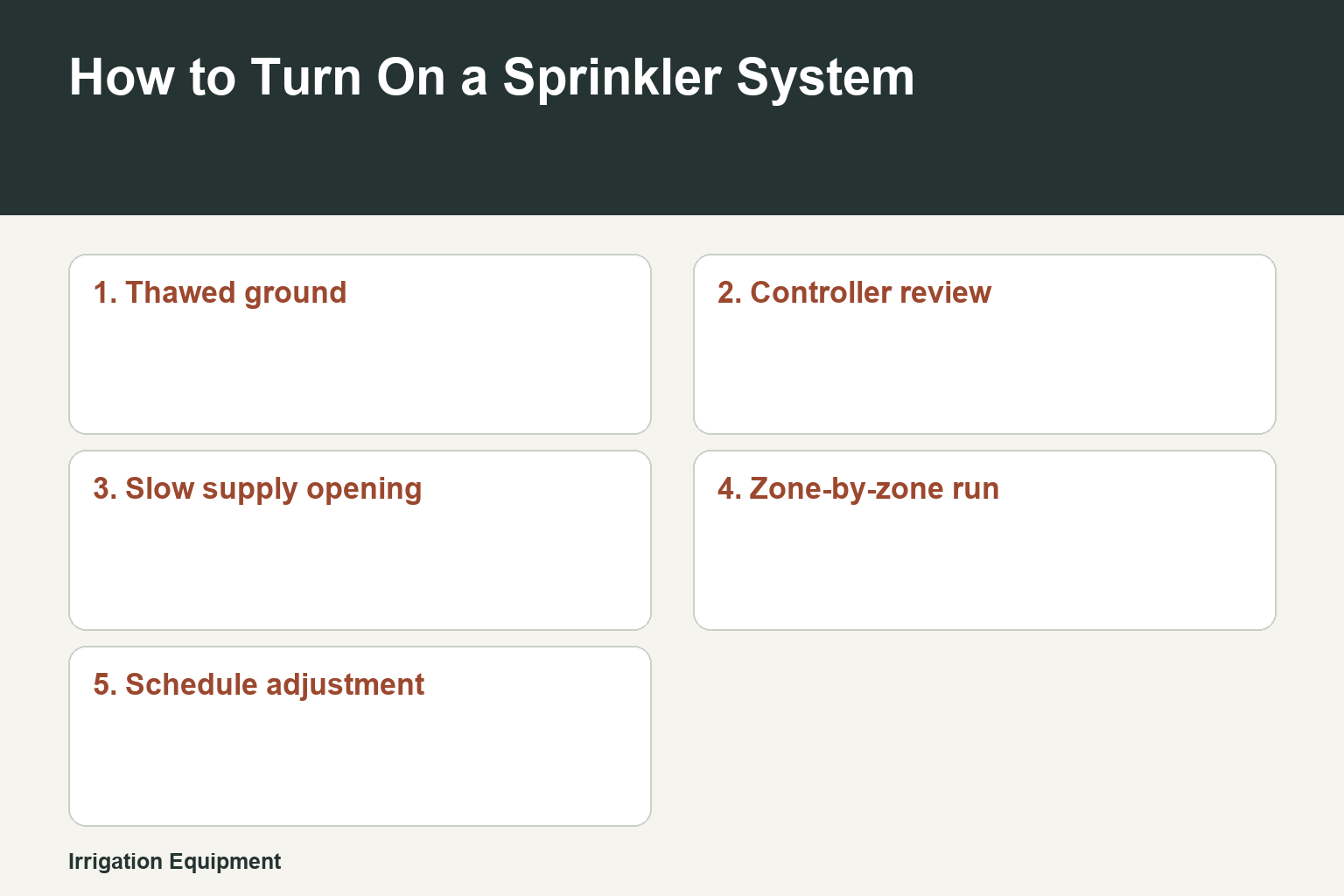
To turn on a sprinkler system, wait until the ground has thawed, review the controller’s date and schedule, then open the water supply slowly. Run one zone at a time on the first cycle so you can look for leaks, blocked or damaged heads, and missed areas before relying on the programmed schedule.
The first startup is an inspection run, not simply a switch-on. A controller can command watering, but the operating zones reveal whether water is reaching the landscape evenly.
- Thawed groundBegin seasonal startup only after thawed conditions are present.
- Controller reviewCheck the current date and watering schedule.
- Slow supply openingGradually restore water to the sprinkler system.
- Zone-by-zone runOperate each zone and observe heads, leaks, and coverage.
- Schedule adjustmentMatch applied water to plant needs and soil storage while avoiding runoff.
The supply is restored before zones are tested; the controller schedule is finalized after operating results are observed.
Start only when the system and ground are ready
Spring activation begins with conditions, not the controller. Wait for thawed ground, then check the controller’s current date and its watering schedule. If your installation has a seasonal water supply shutoff, open that supply slowly rather than abruptly. This lets the system come under pressure gradually before the first zone runs.
1Confirm thawed conditions
Do not begin seasonal operation while the ground remains frozen.
2Review the controller
Check that the date and watering schedule are appropriate before asking the system to run.
3Open the supply slowly
Bring water back to the sprinkler system gradually, then proceed to a zone-by-zone test.
| Check | What to confirm | Why it comes first |
|---|---|---|
| Ground conditions | Ground has thawed | Seasonal startup should wait until thawed conditions. |
| Controller | Date and watering schedule are reviewed | The system should not resume an unsuitable program by default. |
| Water supply | Supply is opened slowly | Gradual pressurization precedes the zone inspection. |
Sources: Rain Bird: Spring Sprinkler Tune-Up
Use the controller to test one zone at a time
After water is available, use the controller to run each zone individually. A zone test makes the results visible: you can see the heads operating on that lateral rather than trying to judge the whole property at once. I view this pass as the useful dividing line between turning a system on and confirming it is ready to irrigate.
1Select the first zone
Start a manual run for one zone from the controller.
2Walk the operating area
Observe the heads and the ground while that zone is running.
3Repeat for remaining zones
Test every zone before treating the programmed schedule as routine operation.
- Evaluate pressure and water delivery while all heads on the operating lateral are running.
- Compare coverage across the irrigated area, not just whether a single head sprays.
Sources: USDA NRCS National Engineering Handbook, Part 652 Irrigation Guide · Rain Bird: Spring Sprinkler Tune-Up
Look for delivery problems during the first run
A system may turn on while still applying water poorly. Leaks, clogged or worn nozzles, and incompatible nozzle sizes can change delivery. If sediment is a concern, a system needs suitable flushing provisions; where a filter is present, pressure on its two sides can indicate a restriction. Address observed problems before depending on the schedule.
- Watch for leaks while each zone operates.
- Notice areas receiving visibly different coverage.
- Check heads for clogging or wear.
- Do not alter reverse-flow protection; it protects the water supply.
| Observation | Possible delivery issue | Useful next check |
|---|---|---|
| Uneven coverage | Clogged or worn nozzles, incompatible nozzle sizes, or leaks may affect delivery | Compare distribution across the area; use catch containers if needed. |
| Filter pressure difference | A restriction may be present | Check pressure on both sides of the filter. |
| Sediment concern | Material can accumulate in the system | Confirm suitable flushing provisions are available. |
Sources: USDA NRCS National Engineering Handbook, Part 652 Irrigation Guide · Rain Bird: Spring Sprinkler Tune-Up
Set watering around the landscape rather than the switch-on date
Once every zone has been observed, set the schedule around plant water needs and the soil’s ability to store water. The goal is to apply water without runoff or unnecessary overwatering. Catch containers can help compare how water is distributed across an area when coverage appears uneven.
- Use the first run to identify coverage issues before increasing scheduled watering.
- Reassess the schedule as plant needs and soil conditions change.
- Treat runoff as a sign that the applied water and site conditions need review.
Sources: USDA NRCS National Engineering Handbook, Part 652 Irrigation Guide
Keep activation separate from seasonal maintenance
Turning the system on is only the beginning of reliable operation. Continue to inspect pressure, discharge, heads, and drainage as part of maintenance. Where freezing is a hazard, drainage should be provided as recommended by the manufacturer; this is a system-specific provision, not a universal instruction to disassemble pipes or valves.
- Inspect operating performance with the relevant lateral running.
- Use drainage arrangements appropriate to the installation where freezing creates a risk.
- Maintain flushing capability where sediment accumulates.
Sources: USDA NRCS National Engineering Handbook, Part 652 Irrigation Guide
Frequently Asked Questions
Should I run every sprinkler zone when turning the system on?
Yes. Run zones individually during the initial check so leaks and coverage problems can be observed in each operating area.
Why should the water supply be opened slowly?
Slow opening is part of the recommended spring startup approach and allows the system to return to operation gradually before zones are tested.
What if one area gets much less water than another?
Compare distribution across the area. Clogging, nozzle wear, leaks, and incompatible nozzle sizes can affect delivery; catch containers can help compare spatial distribution.
Do I need to change the controller schedule after startup?
Review it at startup, then match watering to plant needs and soil storage while avoiding runoff and overwatering.
Final Thoughts
Turn the supply on gradually, test every zone where you can see it, and let what you observe determine whether the controller schedule is ready for normal use.